 Add to Chrome
 Add to Firefox
 Add to Edge
Beyond Independent Manipulation: Individual Fairness-aware Strategic Classification with Peer Imitation
May 30, 2026
Strategic classification (SC) investigates scenarios where agents manipulate their features to obtain favorable decisions from predictive models. Existing fairness-aware SC approaches primarily focus on group fairness and typically assume that agents respond independently. However, when individual fairness is required, ensuring similar individuals receive similar outcomes, agents' manipulation becomes interdependent: an agent's preferred manipulation depends on the neighborhoods' outcomes. This induces a mismatch between classical SC formulations and fairness-aware decision settings, where independent models no longer accurately characterize strategic manipulations. To address this issue, we introduce individual fairness-aware strategic classification (IFSC), a framework that models peer-driven manipulation arising from individual fairness, where agents imitate nearby positively decided peers to obtain favorable outcomes. IFSC characterizes strategic manipulation as similarity-based imitation toward visible accepted peers and learns classifiers under the resulting post-manipulation distributions. To account for uncertainty in peer observability, IFSC employs a robust learning process that introduces stochastic perturbations during manipulation simulation. Experiments on synthetic and real-world datasets demonstrate that IFSC improves individual-fairness consistency and mitigates imitation-induced distortions.

Partial Fairness Awareness: Belief-Guided Strategic Mechanism for Strategic Agents
May 30, 2026Strategic machine learning investigates scenarios where agents manipulate their features to receive favorable decisions from predictive models. To address fairness concerns intrinsic to strategic classification, recent work has introduced group-specific fairness constraints. However, current fairness-aware approaches face a fundamental dilemma in the issue of fairness exposure: making these constraints public enables strategic manipulation and can lead to fairness reversal, while keeping them hidden may reduce social welfare and discourage genuine improvement. To fill this gap, we subsequently propose the problem of partial fairness awareness (PFA), as our theoretical analysis informs that such a dilemma can be mitigated by releasing the candidate set of fairness constraints and concealing the grounding constraint. To be specific, we introduce a belief-guided strategic mechanism, wherein agents iteratively interact with the decision system and maintain a belief distribution over the candidate set of fairness constraints. This belief-guided process enables agents, through iterative interaction and feedback, to update their belief distribution over the candidate set, thereby gradually aligning their belief with the grounding fairness constraint employed by the system. Extensive experiments on real-world and synthetic datasets demonstrate that PFA achieves lower group fairness gaps, higher acceptance of truly qualified individuals, and more stable outcomes compared to fully public or private fairness regimes.
NICE: A Theory-Grounded Diagnostic Benchmark for Social Intelligence of LLMs
May 28, 2026As large language models (LLMs) are increasingly applied in social contexts such as emotional companionship and customer service, measuring their social intelligence has become critical to the quality and safety of human-AI interaction. However, existing social intelligence benchmarks lack a unified framework that organizes social abilities into a unified structure, and therefore cannot enable fine-grained diagnosis. To build the first holistic diagnostic evaluation grounded in social theory, we first construct a social intelligence framework through a literature review and multi-stage expert validation guided by psychometric principles. The resulting framework includes 4 categories and 11 dimensions, each further specified by fine-grained capability facets. Building on this framework, we introduce NICE (Norm, Interaction, Cognition, Experience), a diagnostic benchmark of 137 items operationalized through representative Chinese contexts. Across 5 frontier LLMs and a human reference group, models score higher in aggregate accuracy yet show a consistent weakness in Communication, which the framework localizes to 3 specific capability facets: multi-turn communication, nonverbal communication, and synchrony. NICE thus reframes social intelligence evaluation toward theory-grounded diagnosis of socially consequential weaknesses in LLMs.
When Tabular Foundation Models Meet Strategic Tabular Data: A Prior Alignment Approach
May 19, 2026Tabular foundation models based on pretrained prior-data fitted networks~(PFNs) have shown strong generalization on diverse tabular tasks, but they are typically designed for \emph{non-strategic} settings where data distributions are independent of deployed classifiers. In many real-world decision scenarios, however, individuals may strategically modify their features after deployment to obtain favorable outcomes, inducing a post-deployment distribution shift. This paper studies whether PFN-style tabular foundation models can generalize to such \emph{strategic} tabular data. We show that strategic manipulation creates a mismatch between the non-strategic prior learned during pretraining and the post-manipulation strategic prior, which leads to systematic prediction bias. To address this issue, we propose \textbf{Strategic Prior-data Fitted Network}~\textit{(SPN)}, an inference-time strategy-aware framework that adapts tabular foundation models to strategic environments without retraining. SPN constructs strategic in-context examples to approximate post-manipulation inputs and aligns PFN predictions with the induced strategic distribution. Experiments on real-world and synthetic tabular datasets show that SPN consistently improves robustness and predictive performance under strategic manipulation compared with both tabular foundation models and classical tabular methods.
Beyond Rational Illusion: Behaviorally Realistic Strategic Classification
May 19, 2026Strategic classification(SC) studies the interaction between decision models and agents who strategically manipulate their features for favorable outcomes. Existing SC frameworks typically rely on the idealized assumption that agents are strictly rational. However, evidence from behavioral economics and psychology consistently shows that real-world decision-making is often shaped by cognitive biases, deviating from pure rationality. To formalize this limitation, we identify and define a new problem setting, termed the behaviorally realistic strategic classification problem, where agents' strategic manipulations deviate from full rationality due to psychological biases. Motivated by the identified limitation, we propose the Prospect-Guided Strategic Framework (Pro-SF) to address the problem, a principled framework grounded in prospect theory to model and learn under behaviorally realistic strategic responses. Specifically, to capture behaviorally realistic strategic manipulations, our framework reformulates the Stackelberg-style interaction between agents and the decision-maker by incorporating three key mechanisms inspired by prospect theory, including the asymmetry between benefits and costs, different subjective reference points, and non-rational probability distortion. Experiments on synthetic and real-world datasets establish Pro-SF as a behaviorally grounded approach to strategic classification, bridging machine learning and behavioral economics for more reliable deployment in the real world.
Deep Autocorrelation Modeling for Time-Series Forecasting: Progress and Prospects
Mar 20, 2026Autocorrelation is a defining characteristic of time-series data, where each observation is statistically dependent on its predecessors. In the context of deep time-series forecasting, autocorrelation arises in both the input history and the label sequences, presenting two central research challenges: (1) designing neural architectures that model autocorrelation in history sequences, and (2) devising learning objectives that model autocorrelation in label sequences. Recent studies have made strides in tackling these challenges, but a systematic survey examining both aspects remains lacking. To bridge this gap, this paper provides a comprehensive review of deep time-series forecasting from the perspective of autocorrelation modeling. In contrast to existing surveys, this work makes two distinctive contributions. First, it proposes a novel taxonomy that encompasses recent literature on both model architectures and learning objectives -- whereas prior surveys neglect or inadequately discuss the latter aspect. Second, it offers a thorough analysis of the motivations, insights, and progression of the surveyed literature from a unified, autocorrelation-centric perspective, providing a holistic overview of the evolution of deep time-series forecasting. The full list of papers and resources is available at https://github.com/Master-PLC/Awesome-TSF-Papers.
CausalRM: Causal-Theoretic Reward Modeling for RLHF from Observational User Feedbacks
Mar 19, 2026Despite the success of reinforcement learning from human feedback (RLHF) in aligning language models, current reward modeling heavily relies on experimental feedback data collected from human annotators under controlled and costly conditions. In this work, we introduce observational reward modeling -- learning reward models with observational user feedback (e.g., clicks, copies, and upvotes) -- as a scalable and cost-effective alternative. We identify two fundamental challenges in this setting: (1) observational feedback is noisy due to annotation errors, which deviates it from true user preference; (2) observational feedback is biased by user preference, where users preferentially provide feedback on responses they feel strongly about, which creats a distribution shift between training and inference data. To address these challenges, we propose CausalRM, a causal-theoretic reward modeling framework that aims to learn unbiased reward models from observational feedback. To tackle challenge (1), CausalRM introduces a noise-aware surrogate loss term that is provably equivalent to the primal loss under noise-free conditions by explicitly modeling the annotation error generation process. To tackle challenge (2), CausalRM uses propensity scores -- the probability of a user providing feedback for a given response -- to reweight training samples, yielding a loss function that eliminates user preference bias. Extensive experiments across diverse LLM backbones and benchmark datasets validate that CausalRM effectively learns accurate reward signals from noisy and biased observational feedback and delivers substantial performance improvements on downstream RLHF tasks -- including a 49.2% gain on WildGuardMix and a 32.7% improvement on HarmBench. Code is available on our project website.
Detecting Unobserved Confounders: A Kernelized Regression Approach
Jan 01, 2026Detecting unobserved confounders is crucial for reliable causal inference in observational studies. Existing methods require either linearity assumptions or multiple heterogeneous environments, limiting applicability to nonlinear single-environment settings. To bridge this gap, we propose Kernel Regression Confounder Detection (KRCD), a novel method for detecting unobserved confounding in nonlinear observational data under single-environment conditions. KRCD leverages reproducing kernel Hilbert spaces to model complex dependencies. By comparing standard and higherorder kernel regressions, we derive a test statistic whose significant deviation from zero indicates unobserved confounding. Theoretically, we prove two key results: First, in infinite samples, regression coefficients coincide if and only if no unobserved confounders exist. Second, finite-sample differences converge to zero-mean Gaussian distributions with tractable variance. Extensive experiments on synthetic benchmarks and the Twins dataset demonstrate that KRCD not only outperforms existing baselines but also achieves superior computational efficiency.
Learning Counterfactual Outcomes Under Rank Preservation
Feb 10, 2025Counterfactual inference aims to estimate the counterfactual outcome at the individual level given knowledge of an observed treatment and the factual outcome, with broad applications in fields such as epidemiology, econometrics, and management science. Previous methods rely on a known structural causal model (SCM) or assume the homogeneity of the exogenous variable and strict monotonicity between the outcome and exogenous variable. In this paper, we propose a principled approach for identifying and estimating the counterfactual outcome. We first introduce a simple and intuitive rank preservation assumption to identify the counterfactual outcome without relying on a known structural causal model. Building on this, we propose a novel ideal loss for theoretically unbiased learning of the counterfactual outcome and further develop a kernel-based estimator for its empirical estimation. Our theoretical analysis shows that the rank preservation assumption is not stronger than the homogeneity and strict monotonicity assumptions, and shows that the proposed ideal loss is convex, and the proposed estimator is unbiased. Extensive semi-synthetic and real-world experiments are conducted to demonstrate the effectiveness of the proposed method.
Decomposing and Fusing Intra- and Inter-Sensor Spatio-Temporal Signal for Multi-Sensor Wearable Human Activity Recognition
Jan 19, 2025
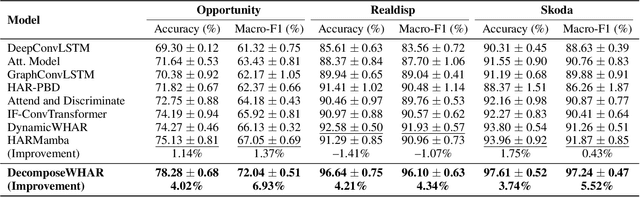

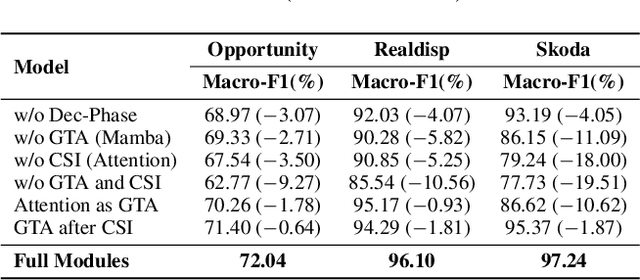
Wearable Human Activity Recognition (WHAR) is a prominent research area within ubiquitous computing. Multi-sensor synchronous measurement has proven to be more effective for WHAR than using a single sensor. However, existing WHAR methods use shared convolutional kernels for indiscriminate temporal feature extraction across each sensor variable, which fails to effectively capture spatio-temporal relationships of intra-sensor and inter-sensor variables. We propose the DecomposeWHAR model consisting of a decomposition phase and a fusion phase to better model the relationships between modality variables. The decomposition creates high-dimensional representations of each intra-sensor variable through the improved Depth Separable Convolution to capture local temporal features while preserving their unique characteristics. The fusion phase begins by capturing relationships between intra-sensor variables and fusing their features at both the channel and variable levels. Long-range temporal dependencies are modeled using the State Space Model (SSM), and later cross-sensor interactions are dynamically captured through a self-attention mechanism, highlighting inter-sensor spatial correlations. Our model demonstrates superior performance on three widely used WHAR datasets, significantly outperforming state-of-the-art models while maintaining acceptable computational efficiency. Our codes and supplementary materials are available at https://github.com/Anakin2555/DecomposeWHAR.